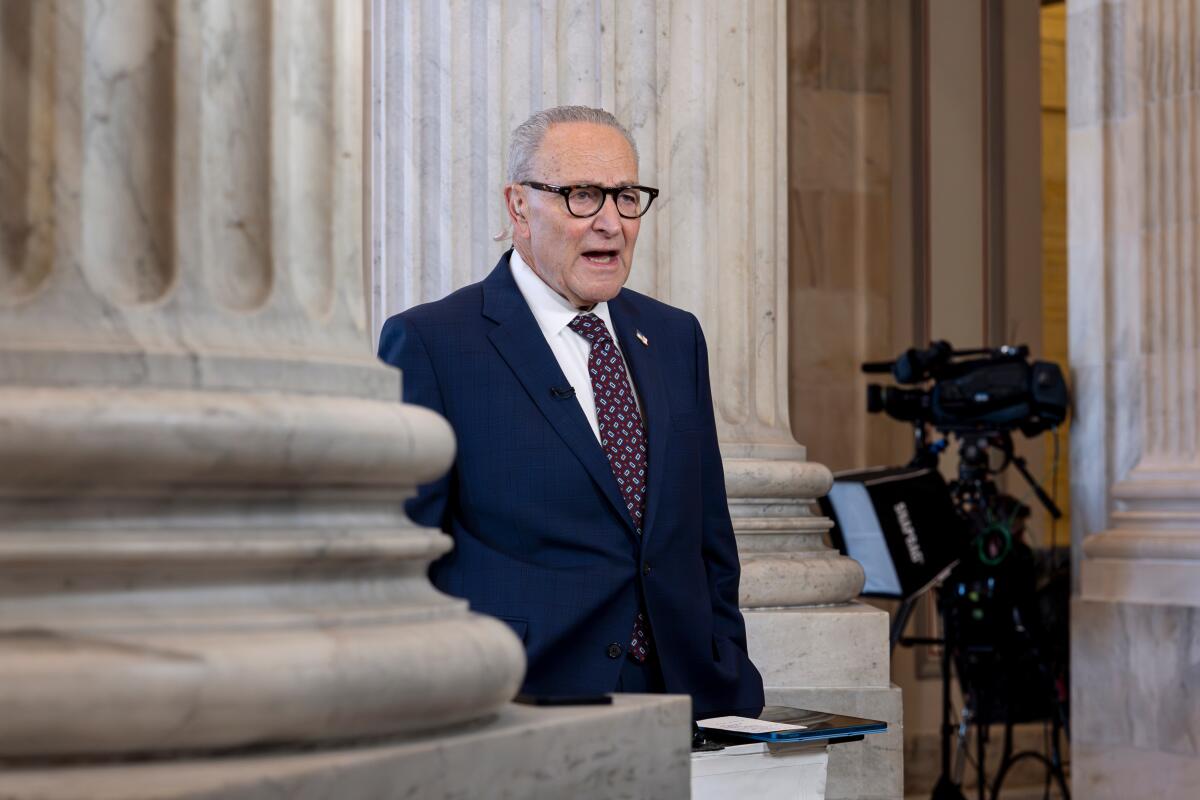
Senate Minority Leader Chuck Schumer speaks during a TV interview Thursday in the Capitol.
(J. Scott Applewhite / Associated Press)
By
Gavin J. QuintonStaff Writer
Feb. 5, 2026
1:47 PM PT
5 min
Click here to listen to this article
Share via
Close extra sharing options
Email Facebook X LinkedIn Threads Reddit WhatsAppCopy Link URL
Copied!
0:00
0:00
1x
This is read by an automated voice. Please report any issues or inconsistencies here.
Democrats are demanding a slate of reforms including body cameras and warrant requirements to fund Homeland Security.
Republicans say that another short-term extension is probably needed before the Feb. 13 deadline.
WASHINGTON — Senate Republican Leader John Thune warned Thursday that Congress is not close to an agreement to fund the Department of Homeland Security, signaling that another short-term extension may be the only way to avoid a shutdown as Democrats demand “nonnegotiable” ICE reforms ahead of the Feb. 13 deadline.
The Republicans are increasingly looking to punt the full funding package a second time if negotiations collapse. Speaking on the Senate floor Thursday, Thune said that such a move would not include any reforms lawmakers had previously negotiated, including body cameras for immigration agents.
“As of right now, we aren’t anywhere close to having any sort of an agreement that would enable us to fund the Department of Homeland Security,” he said. “If [Democrats] are coming to the table demanding a blank check or refusing to consider any measures but their own, they’re likely to end up with nothing.”
Advertisement
He spoke hours after House and Senate Democrats announced they were aligned behind a list of 10 demands they say must be passed before approving the Homeland Security funding package through September.
 Inside a Minneapolis school where 50% of students are too afraid of ICE to show up
‘Operation Metro Surge,’ the immigration crackdown in Minnesota that led to nationwide protests after federal agents shot and killed two U.S. citizens, has had students, parents and teachers on edge regardless of their immigration status.
Feb. 2, 2026
Democrats are pressing for statutory limits on immigration raids, new judicial warrant requirements, body-worn cameras, identification rules for agents and enhanced oversight of Immigration and Customs Enforcement and Customs and Border Protection — reforms they say are necessary to rein in what House Minority Leader Hakeem Jeffries (D-N.Y.) called an agency “out of control.”
Senate Minority Leader Chuck Schumer (D-N.Y.) said Democrats are planning to propose the legislation as soon as possible.
Advertisement
“We want our Republican colleagues to finally get serious about this, because this is turning America inside out in a way we haven’t seen in a very long time,” Schumer said.
The coordinated demands signal unity among House and Senate Democrats after a rocky week on Capitol Hill. In a slim vote, 21 House Democrats joined Republicans on Tuesday to end a partial government shutdown by temporarily extending Homeland Security funding through Feb. 13.
The two-week stopgap, called a “continuing resolution,” was meant to leave time for the two parties to debate how to rein in ICE after the fatal shootings of two U.S. citizens in Minneapolis.
But that truce has quickly unraveled. Republican leaders have little appetite for the full slate of reforms. Some have indicated openness to narrower changes, such as expanding body camera programs and training, but reject mask bans and the removal of Homeland Security Secretary Kristi Noem.
House Speaker Mike Johnson (R-La.) has already ruled out warrant requirements, which would limit immigration agents from entering private property without a court order. In remarks to reporters Wednesday, he also hinted at some interest in attaching voter ID and anti-sanctuary city policies to negotiations.
“It will be part of the discussion over the next couple of weeks, and we’ll see how that shakes out. But I suspect that some of the changes — the procedural modifications with ICE, Immigration and Customs Enforcement — will be codified,” he said.
Advertisement
Johnson was confident the two sides could make a deal without further delays, adding that negotiations are largely between “the White House, Schumer and Senate Democrats.”
President Trump has privately supported the short-term extension to cool tensions while publicly defending immigration agents and expressing skepticism toward Democrats’ reform push, according to House leadership.
White House border policy advisor Tom Homan also announced a drawdown of 700 federal agents from Minneapolis this week as what officials framed as a goodwill gesture amid negotiations.
Karoline Leavitt, the White House press secretary, said Thursday that the administration is willing to consider some of the demands Democrats have made, but said some of their requests are not “grounded in any common sense and they are nonstarters for this administration.”
 Democrats demand ‘dramatic changes’ for ICE regarding masks, cameras, judicial warrants
Congress is discussing potential new rules for ICE and U.S. Customs and Border Protection after officers shot and killed two Minneapolis protesters in January.
Feb. 4, 2026
Leavitt did not specify which reforms the administration was willing to consider. She did, however, say the president is committed to keeping the government open and supporting “immigration enforcement efforts in this country.”
The White House did not respond when asked if the president would support a short-term spending measure should negotiations stall.
Advertisement
Republicans continue to warn that a failure to reach a deal would jeopardize disaster response funding, airport security operations, maritime patrols, and increased security assistance for major national events, including the upcoming World Cup in Los Angeles.
“If we don’t do it by the middle of next week, we should consider a continuing resolution for the rest of the year and just put this all behind us,” said Rep. Andy Harris (R-Md.), chair of the House Freedom Caucus.
Democrats, however, remain adamant that verbal assurances are no longer enough.
“These are just some of the commonsense proposals that the American people clearly would like to see in terms of the dramatic changes that are needed at the Department of Homeland Security before there is a full-year appropriations bill,” Jeffries said.
Times staff writer Ana Ceballos in Washington contributed to this report.
More to Read
 Trump signs bill to end partial government shutdown, setting stage for next fight
Feb. 3, 2026
 Johnson says no quick House vote to end partial shutdown, blames Democrats
Feb. 1, 2026
 Trump moved fast to cut a funding deal. It’s a striking change from the last shutdown fight
Jan. 31, 2026